
Finance Minister Nirmala Sitharaman has brought down the budgetary allocation for the fertiliser subsidy for FY21 to Rs 71,309 crore, from the RE of Rs 79,998 crore for FY20, while increasing food subsidy to FCI through "ways and means advance" to Rs 50,000 crore for FY21, from Rs 36,000 crore in RE for FY20, and under the National Food Security Act (NFSA) to Rs 77,982 crore, from Rs 75,000 crore.

India's economy is unlikely to see double-digit growth and may grow between 8 per cent and 9 per cent this fiscal year (2021-22, or FY22), against the estimated 11.5 per cent, according to leading economists and rating agencies. The downward revision of growth projections to as low as 10 per cent is mostly on account of stringency in restrictions by states, relatively slow vaccination pace, and the possibility of a third wave of the pandemic. However, they say the impact will not be as severe as the first wave, and expect the first quarter to see positive growth.

The government's subsidies on food, fertilisers and petroleum are estimated to decline by 39 per cent to Rs 4,33,108 crore this fiscal and fall further by 27 per cent to nearly Rs 3.18 lakh crore in 2022-23. In its revised Budget (RE) estimate for the 2021-22 fiscal, the government has pegged total subsidies to be at Rs 4,33,108 crore against the actual Budget estimate of Rs 7,07,707 crore in the previous financial year. Out of which, the food subsidy is estimated to decline to Rs 2,86,469 crore in the current fiscal from Rs 5,41,330 crore in 2020-21, while petroleum subsidy is estimated to fall to Rs 6,517 crore from Rs 38,455 crore in the said period.

Output of capital goods -- a proxy for infrastructure investments in the country -- contracted 1 per cent in July

Notwithstanding the fact that the country's pharmaceutical (pharma) pricing regulator has allowed a 12 per cent price increase for medicines listed under the National List of Essential Medicines (NLEM) in 2023, analysts and industry insiders predict that the overall domestic pharma industry will only witness a price hike of 5-6 per cent. This is attributed to higher competitive intensity in the market. Krishnakumar V, executive director and chief operating officer (CEO) of Eris Lifesciences, a domestic-focused pharma company, noted that the NLEM segment experienced growth suppression of around 150 basis points due to price reductions during the January to July period this year.

The decision to scrap the plan for landless workers and focus only on small and marginal farmers was made as there was no proper method to find out who qualify as landless labourers.

While presenting her 2021-22 Union Budget, Finance Minister Nirmala Sitharaman had set a fiscal deficit target of 6.8 per cent of nominal gross domestic product (GDP) against the 2020-21 Revised Estimate of 9.5 per cent. The fiscal correction in the upcoming 2022-23 Union Budget is unlikely to be that steep. Even as discussions among top Budget-makers are ongoing, the fiscal deficit target for 2022-23 may likely be in the range of 6.5-6.8 per cent.

March requires 20% jump to meet year's goal; CBDT chief tells staff to sweat it out to meet target

The International Monetary Fund (IMF) on Tuesday lowered India's economic growth projection for the current fiscal to 5.9 per cent from 6.1 per cent earlier. Yet India will continue to be the fastest-growing economy in the world. In its annual World Economic Outlook, IMF also lowered the forecast for 2024-25 fiscal (April 2024 to March 2025) to 6.3 per cent from the 6.8 per cent it had predicted in January this year. The growth rate of 5.9 per cent in the 2023-24 fiscal compares to an estimated 6.8 per cent in the previous year.

Lead indicators suggest that domestic current account deficit (CAD) is likely to reduce in 2023, while macro-economic stability has received a boost from inflation being brought back to the official tolerance band, according to the Reserve Bank of India's (RBI's) January 2023 Bulletin. "With the merchandise trade deficit reaching an all-time high of $83.5 billion in a quarter, and a rise in net outgo from the income account, the current account deficit increased to 4.4 per cent of GDP in Q2FY23," the State of the Economy article in the bulletin said. "It is noteworthy, however, that the CAD for Q1 was revised down from 2.8 per cent to 2.2 per cent on account of downward adjustment in Customs data.

The brokerage believes the economic growth cycle is not fully priced in. It has revised upwards the earnings per share (EPS) estimate for Sensex.

The health and family welfare ministry spent 70 per cent of its allocation till October. The ministry may need additional funds for the vaccination drive which is expected to be kicked off from January.

If this happens, it will be an "unprecedented development" in the civic body's journey as budget is traditionally passed by a House, they said.

The churn in Indian labour markets will be led by technology-driven sectors like artificial intelligence and machine learning (38 per cent), followed by data analysts and scientists (33 per cent) and data entry clerks (32 per cent).

The main purpose of the meeting is to assess their views on reforms that are required to attract long-term capital into the country.

The International Monetary Fund (IMF) on Tuesday cut its economic growth forecast for India to 9.5 per cent for the fiscal year to March 31, 2022 as the onset of a severe second COVID-19 wave cut into recovery momentum. This forecast for 2021-22 is lower than the 12.5 per cent growth in GDP that IMF had projected in April before the second wave took a grip. For 2022-23, IMF expects economic growth of 8.5 per cent, larger than the 6.9 per cent it had projected in April.

Amid cooling raw material prices, the crude-oil linked companies, which includes paint and tyre firms, have been on a roll over the past one year. Shares of related companies have gained up to 84 per cent, as against a 14 per cent rise in the S&P BSE Sensex. Analysts, however, believe stretched valuations in both these sectors could trigger a de-rating.
The Reserve Bank is expected to go for another rate hike of 0.40 per cent at the scheduled review of the monetary policy next week, a foreign brokerage said on Friday. The central bank's rate setting panel will follow it up with a 0.35 per cent hike in rates at the next review in August, or make it into a 0.50 per cent hike next week and a 0.25 per cent increase in August, to make the total quantum of rate hikes at 0.75 per cent, the report by Bofa Securities said. On May 4, the Reserve Bank of India (RBI) hiked rates by 0.40 per cent, and Governor Shaktikanta Das has already called a rate hike at the forthcoming review as a "no brainer" given the pressure to maintain its core mandate of inflation in the targeted band of under 6 per cent.

The government further said the gross tax revenue as a per cent of GDP is expected to increase to 12.1 per cent of GDP in 2019-20 and stabilise at that level in 2020-21 before climbing up to a level of 12.2 per cent of GDP.

As of December 2021, Netflix India stood at an estimated 5 million subscribers against 46 million for Disney+Hotstar and 19 million for Amazon Prime Video.

Finance ministry's drive is meant to meet fiscal deficit target and improve overall efficiency in government spending.

Net new enrolments with retirement fund body EPFO grew by nearly 20 per cent to 12.37 lakh in February compared to the same month in 2020, according to the payroll data released on Tuesday, providing a perspective on formal sector employment amid the coronavirus pandemic. The provisional payroll data of EPFO highlights a growing trend with the addition of 12.37 lakh net subscribers during the month of February, 2021, a Labour Ministry statement said. The data reflects growth of 3.52 per cent in net subscribers addition in February 2021 over January 2021.

This comes at a time when the COVID-19 crisis is expected to derail the government's revenue maths for 2020-21, hitting the mop-up from sources such as taxes and divestment.

Lump sum investments in equity and hybrid schemes of mutual funds (MFs) declined to Rs 17,900 crore in October - the lowest since January 2021. The fall in lump sum investments comes even as flows through systematic investment plans (SIPs) rose to a new all-time high of Rs 13,000 crore in October. The latest lump sum tally is just a third of the peak inflow of Rs 49,700 crore in July 2021.

Experts believe that under-reporting is likely to cause an underestimation of the spread of the disease.

BofA Securities has revised its year-end Nifty target from its earlier projection of 16,000 to 14,500 now - down over 6 per cent from the current levels. Fast tightening monetary conditions, slowing growth/fears of US recession and the likely Nifty EPS (earnings per share) cuts, BofA Securities said, are the key headwinds for the markets in the near-term. However, clarity on macro and monetary policy outlook in the US/India, it said, is the silver lining that could see markets bottom out by August/September 2022.

In the current fiscal, as per the revised estimate, these two companies raised Rs 14,942 crore (Rs 149.42 billion) from markets.
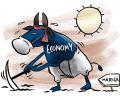
Almost 63 per cent of the increased allocation of around Rs 1.01 trillion has been spent in the first five months of 2020-21.

Businesses are still taking time to adjust in the new tax regime, which would weigh on growth rates for the financial year closing today.

'Nirmalaji's Budget announcements have long-term implications and are not backed by enough money when the short-term outlook looks bleak,' notes T N C Rajagopalan.

The executive enclave will house the new Prime Minister's Office, Cabinet Secretariat, India House and the National Security Council Secretariat.

The previous high GDP growth of 8.1 per cent was recorded in April-June quarter of 2016-17.
Fitch Ratings on Thursday slashed India's GDP growth projection for FY23 to 7 per cent, saying the economy is expected to slow against the backdrop of global economy, elevated inflation and high interest rate. In June, it had forecast 7.8 per cent growth for India. "We expect the economy to slow given the global economic backdrop, elevated inflation and tighter monetary policy. "We now expect the economy to grow 7 per cent in the financial year to end-March 2023 (FY23) from 7.8 per cent previously, with FY24 also slowing to 6.7 per cent from 7.4 per cent before," Fitch said in its September edition of the Global Economic Outlook.

About 3.2 million people could have died from Covid in India by September last year, six-seven times higher than reported officially, according to a study based on one independent and two government data sources.

The Asian Development Bank (ADB) on Wednesday slashed India's GDP growth forecast for FY23 to 7 per cent from the earlier estimate of 7.2 per cent mainly on account of higher inflation and a tight monetary policy. India's economy grew 13.5 per cent year-on-year in the first quarter of 2022-23, reflecting strong growth in services, ADB said in its second supplement to Asian Development Outlook Report 2022 (ADO 2022). "However, GDP growth is revised down from ADO 2022's forecasts to 7 per cent for FY2022 (ending March 2023) and 7.2 per cent for FY2023 (ending March 2024) as price pressures are expected to adversely impact domestic consumption, and sluggish global demand and elevated oil prices will likely be a drag on net exports," ADB said.

Consolidated net profit rose to Rs 3,465 crore in its fiscal third quarter to December 31.

Families with tax-paying members, government employees, professionals, among those who have been exempted from the Pradhan Mantri Kisan Samman Nidhi (PM-KISAN) scheme.

The total debt of the government increased by 6.7 per cent in the second quarter ended September 2013.

Budget for 2022-2023 has returned to its agenda for protectionism in the name of creating a self-reliant India, points out A K Bhattacharya.

The vacancies are learnt to be impacting the I-T department's day-to-day functioning.
